Monday, 4 August 2014

... A war to end all wars?!


Image Walter Kleinfedt (1917). His son, Volkmar, sais "this image is like an accusation, an accusation against war"

AT dawn the ridge emerges massed and dun
In the wild purple of the glow'ring sun,
Smouldering through spouts of drifting smoke that shroud
The menacing scarred slope; and, one by one,
Tanks creep and topple forward to the wire.
The barrage roars and lifts. Then, clumsily bowed
With bombs and guns and shovels and battle-gear,
Men jostle and climb to meet the bristling fire.
Lines of grey, muttering faces, masked with fear,
They leave their trenches, going over the top,
While time ticks blank and busy on their wrists,
And hope, with furtive eyes and grappling fists,
Flounders in mud. O Jesus, make it stop!

Saturday, 21 June 2014

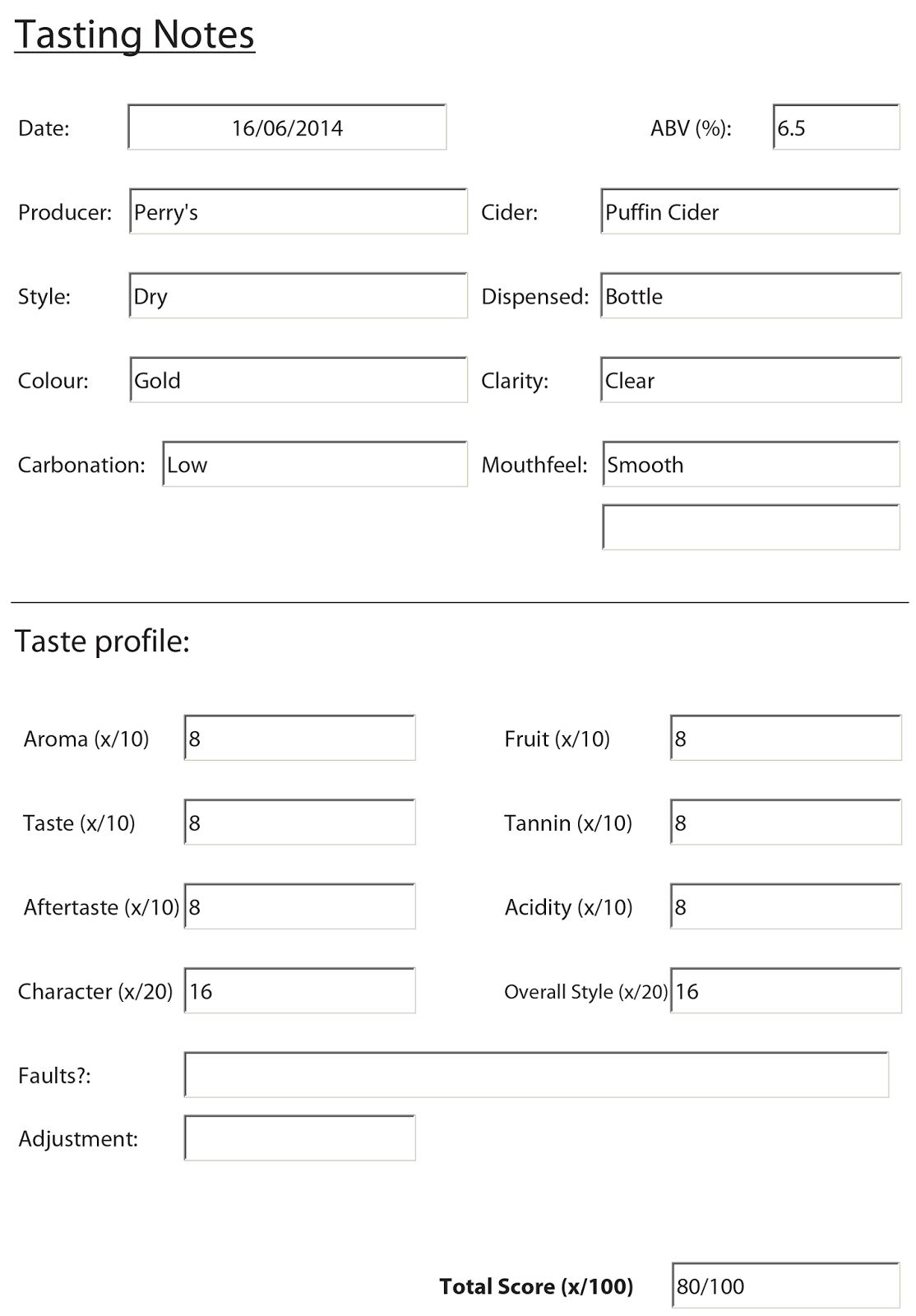
Perry's Puffin Cider


My goodness... I am writing a review for a cider that I drank nearly three weeks ago! Well, I guess this will be testament (or not) to my record keeping! What I can say - as something of a spoiler - is that it is a worthy cider to follow my absence.

Well, I still haven't recovered my pad so I cannot continue the others yet:-)

Puffin cider is another of the Perry's bottle conditioned range - 'using small batch processes'. What this means is that it should be slightly sparkling with a crop of yeast at the bottom (not put there as some kind of artificial cloudiness or dead yeast addition).

Looking at it, this is the dry version, and at 6.5% its all it is claimed so far. I should add that I can also see the yeast settled at the bottom.

Sure enough, it has a low level sparkle and once out of the bottle I can see it is a lovely golden colour. It is rich smelling - a touch yeasty if I am being particularly picky but it feels mature and tannic.

The taste itself is dry - medium dry, but very melow and full bodied. There is some sharpness to it but mostly the experience is deep, fruity cidery notes. The tannin is quite low stated, but it does develop in the mouth to leave it a little drier in the finish.

The aftertaste is also low level and moderate in length. Overall, this is a lovely cider and well presented. And to think I was worried that Perry's might be going in the same direction as Orchard Pig... phew!

A score of 80/100 gives Perry's a silver apple for Puffin. Right up my street!!

Wednesday, 18 June 2014

Heritage English Cider and the missing cider blogger...

First off, may I humbly apologise for being absent for, well, a month.

It wasn't you, it was me!

There are ciders waiting to be written up and there are ciders waiting to be tasted... there is even a 'missing' notepad with my last reviews from Winchester Beer Festival back in March! (n.b. to self - I haven't got my GBBF ticket yet!!)

However, I have been very busy. Not just busy selling cider to people... or busy winning a couple (or more) awards for my cider... (which is always great!). Lets face it, those are the things I want to be doing. Not even just doing a bit of judging of ciders... though that was a lot of fun! Nope, this is a little different...

You see, I have been involved in writing, consulting, re-writing, talking, meeting and finally getting a presentation for a proposal of a PGI for well made, traditional English cider and perry. Well, I have hinted at it no here for some time eh. And it looks like it has got some legs to it.

The aim for a 'Heritage English Cider/Perry PGI' is to showcase the highest quality cider and perry produced within England and set a standard for quality products way beyond the pretty loose regulations set by HMRC. It seeks to differentiate the good stuff from the lower juice, mass produced 'brands' and to create something that is recognisable to the public.

A PGI, or Protected Geographical Indication, is a device used within and run by the EU via DEFRA (in the UK). It sets out regulations and criteria for a product - essentially ensuring that traditional products and methods can be protected and promoted. Sounds just right for high juice cider eh! Beyond that, criteria for quality can be included within the PGI - well, it is true that both the best AND worst ciders in England are traditionally made, high juice ciders! (though I realise some may disagree with the 'worst' bit:-)

It all started some 12-18 months ago and has taken time to get to a point where discussions can be held with the National Association as well as attempting to consult with as many craft/high juice producers as possible. And now it has been presented at the Cider Trends summit in Bristol it is well and truly in the public domain.

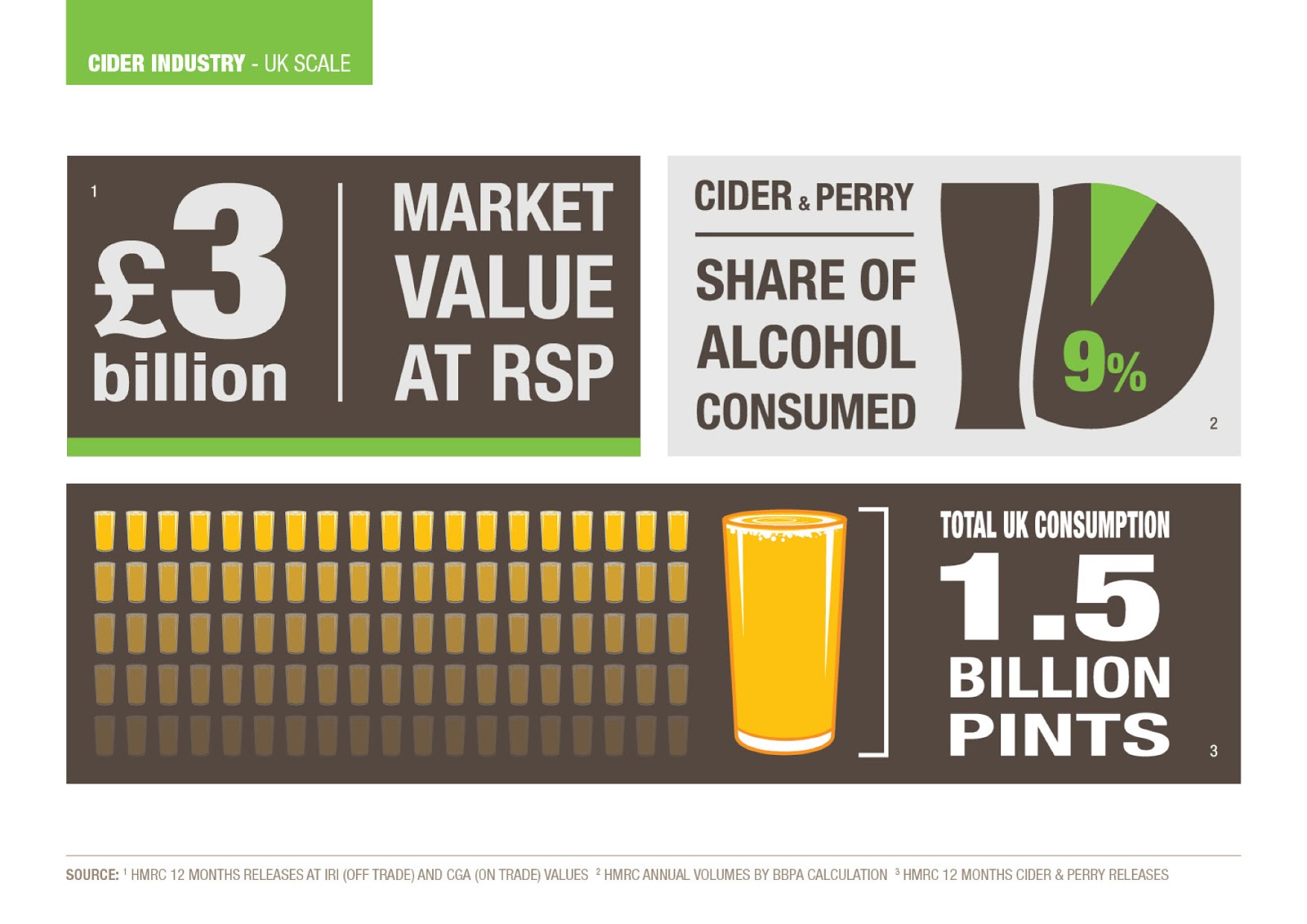
The nuts and bolts are found in the 'infographic' below... well, when you are presenting to PR and marketing types it is wise to at least try and speak the language:-)


click for larger version

Done well, it could add value to high juice cider and maybe even encourage some to raise their bar a little. And it does all of this without throwing any toys out of the pram, upsetting the 'apple cart' and allows the larger family of cider producers to continue to innovate and/or do whatever they do.

With nearly 50 producers signalling their support for the PGI so far - and more looking at it (and yet to look at it), this process is not complete yet. However, it has dispelled the common opinion that cidermakers cannot agree on anything - or that we aren't organised enough to do something new!

There are so many reasons for applying for a PGI - reinforcing traditionally made cider/perry and separating them from the mass produced cider is one thing (it will only be when numbers of producers are using it that it becomes a recognisable and reliable indication). It is also something that cider and perry producers can pin their credentials to... without having to comply with silly 'definitions' and restrictions on parts of the process that, quite frankly, just end up misleading and confusing drinkers all the more!

And saying that, it is probably worth saying that this is a process worked out by cider/perry producers for the benefit of the drinkers. Of course opinions are always welcome from anyone; its just that the opinions that will make a difference are those of producers.

There is a lot of work still left to do - but hopefully I can at least get back to the ciders and perries - after all, the drinking is so much more fun than the talking! I will post more detailed information as I am able.

Sunday, 27 April 2014

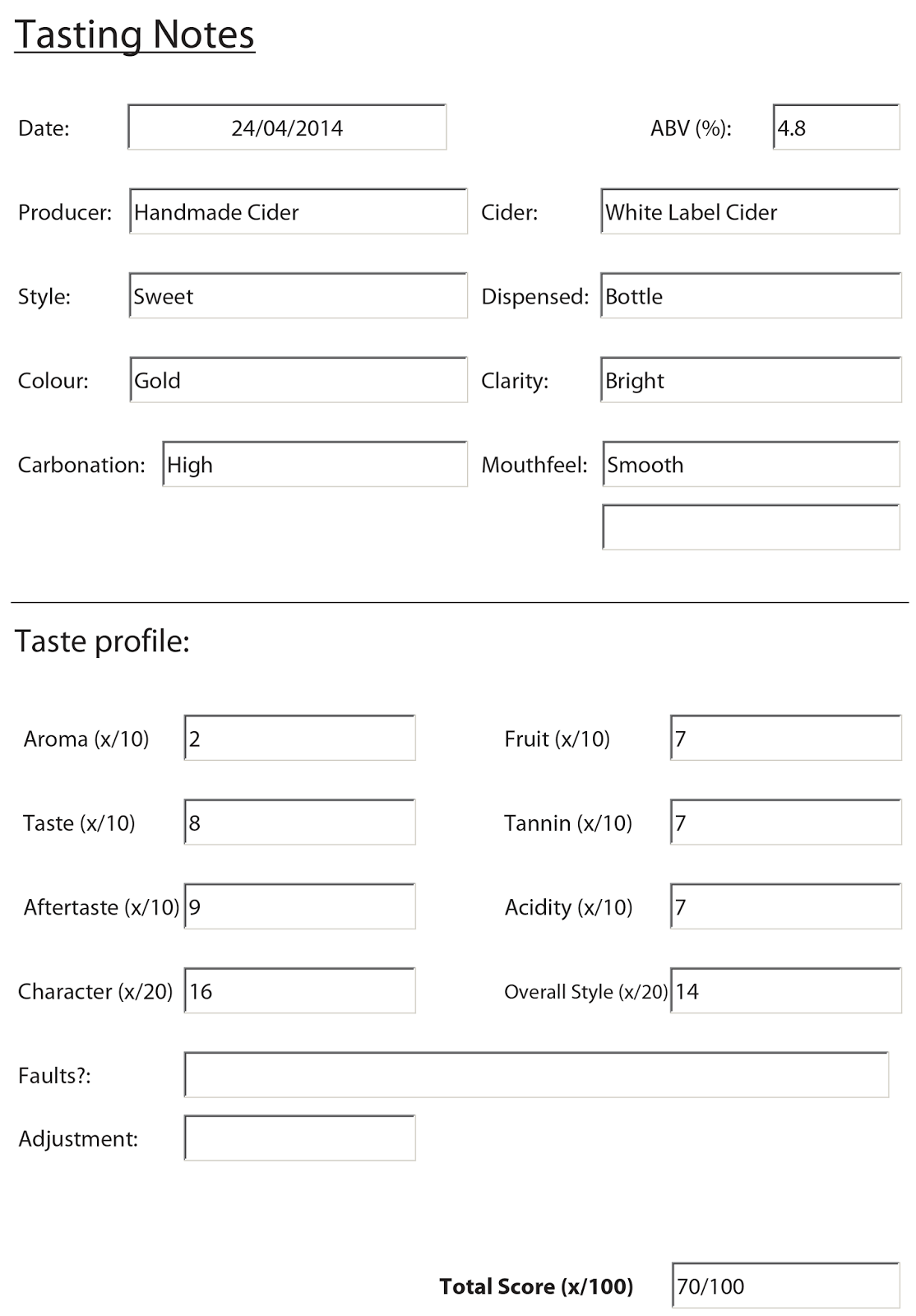
Handmade Cider, White Label Cider


A cider maker that I haven't tried before. Well, that is not strictly true - I did try some of their cider at the Winchester Festival, but sadly that isn't written up yet and so will become the second (or even third) of their ciders that I try.

The first thing I always do with a cider is have a look at the bottle. I guess its just the blogger in me... or possibly the marketeer. Apart from the cider itself it is interesting to see what the producer (or their representatives) want to say to me, the drinker, before I experience the drink itself. Something that has caught my eye on this bottle is this; "Produced from a batch of 1000 litres.". Now that is what I am talking about... how craft cider is that? OK, I also notice that it is naturally sweet in the French style. So, is this keeved then? (for those who are unfamiliar with the idea, it is basically removing the nutrients from the juice prior to fermentation. This makes things move along much slower and eventually stop before the cider has reached a dry state). That isn't easy or guaranteed - so I am surprised to be finding it in a normal beer bottle!

OK, lots to explain there!! Keeving is not always stable. You see, the yeast will consume all the sugar in a cider leaving it dry (no - sweet apples don't make sweet cider!). It is quite hard to stop unless you intervene (pasteurise or sterile filter) and kill off the yeast or set things up so that they 'get stuck' (stop before all the sugar is devoured by the yeast). By far and away the most elegant of these processes is keeving (though there is nothing wrong with either method - in fact it is probably preferable to back sweetening with sugar, juice or artificial sweetener!)

However (and its a biggy) because keeving is not guaranteed it could start fermenting again and, therefore, needs heavy duty bottles to contain any gas production... hence French cidre is often found in heavy, punted bottles. So this is either very brave or else the yeast has been killed off in some way.

OK, it pours out deep golden and highly carbonated... see my comments above. I have to say it does smell quite yeasty too - lots of farmyard... in fact, that may not be the nicest smelling cider I have ever had. I suspect it has continued to ferment in the bottle and the low nutrients may have stressed the yeast and caused this eggy/farm yard smell.

Lets move on to the taste, as that is what is important. It is very mellow - lovely cider fruit coming through and almost a touch juicy in a French way. There isn't a lot of acid in here, but it does taste nicely mature with a low level of tannins that emphasises the fruit rather than compete with it.

The aftertaste is also mellow. This is easy drinking and crafted - it is just such a shame about the damn smell of it!

I said just now that it was the taste that is important. This is true, but it is not true that it doesn't matter about the smell. Experiencing a cider is the whole package - including the smell. So sadly it is going to lose marks based on that. I am certainly going to look out for another bottle of this at some point though to see if I just had an errant bottle.

It scores 70/100 and earns a bronze apple. I may have been a little generous based on the taste of the cider - some would certainly not even try it once they smelt it...


Thursday, 24 April 2014

Dunkerton's Browns Cider


My humble apologies for going absent for the last few weeks. I have been distracted by other things and only now realise how long it has been.

I managed to mislay my notes for the cider reviews from Winchester Ale and Cider Festival - which I have still not got back yet (I know where they are but have to go and fetch them)! Never mind, in a week or two I will have them back... it's worth the wait - honest!!!

And so, for my next review I turn back to a tried and trusted producer; Dunkertons. It would have been nice for this to have followed the review of the Worley's version I tried at Winchester, but there you go. This is a yardstick for that then.

I really like the labels that Dunkertons put on their bottle (OK,  with the exception of the organic thing). This one is simple, bold and delivers sufficient information without being patronising or in any way 'salesy'. Isn't that what a label is supposed to do? Fair enough, it is labelling at it's simplest, but they manage to do it this way for each of their ciders without giving in to the temptation to put a picture of a drunken farmer on it:-)

Not being that sure if I have tried a Browns before, here is a little information about the variety: Originating in Devon during the early 1900's (the period when a lot of varieties come from). It is a bright red, bittersharp variety of apple used predominantly for cider. It harvests mid season too, making it a useful apple to put against the bittersweets to produce a good balanced west country cider.

This cider pours light golden in colour, bright and with a light sparkle. It smells very earthy - low dull fruit with a very clean sense about it. That could well be the sharpness of the variety on display. It is certainly inviting!

To the taste: it is more a medium than a medium dry, though I can see the sweetening being used as a tool to control the sharpness a touch. It is very nice though. A very deep fruit going on which is rich and sharp. There is tannin, but this is very restrained by everything else. It is the acid that is definitely most notable of the two. Saying that, this isn't one dimensional - it is a complex drink with bold flavours as well as a sharpness. Not one for cider virgins (I think).

How to describe the flavour? Well, it has farmyard right through it - or orchards... you know what I mean. There is also a funkiness in the flavour that I can only describe as being the same as an SV Yarlington Mill. I like it, but have never come across it apart from YM.

The aftertaste is long, fruity and luscious (that is what I have written down!) A real treat.

A very respectable score of 82/100 gives Dunkertons a silver apple. Having now taken the time to check it is their 6th Silver Apple to go alongside a couple of Golds... way to go:-)


Wednesday, 9 April 2014

Cider Differentiation...

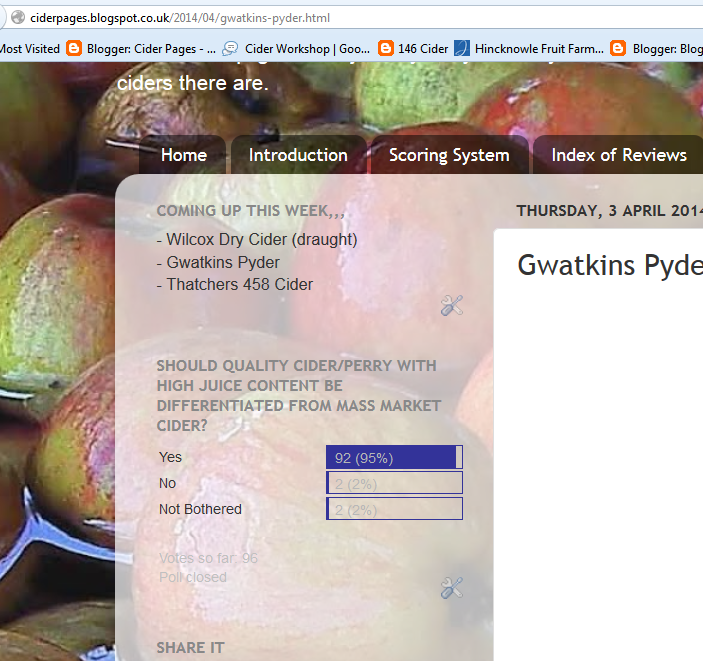
Having taken a poll asking specifically whether high juice cider ought to be differentiated from the stuff on the mass market, I did say that I would report back once it was done with the results. No, I am not going to try and put together some clever graphs to justify an argument - I have a healthy skepticism of statistics and polling. Here, though, is an image of the final results for the poll:


On the face of it, it is a clear 98% message that quality, high juice cider does need something to identify it from the mediocrity of mass produced ciders. Only 4% either didn't care or disagreed (and I think that one of those may have been me testing the form out:-) Do bear in mind though that by and large this blog is read by people who are bothered to look up the cider they are drinking... even though I hope that some of those are coming to cider from the mainstream. Also bear in mind that 100 odd votes is not exactly representative of those consuming cider in the UK.

That aside, it is a clear message. And if I am to put my cards firmly on the table I am very happy with the result - I feel that there has started to be a groundswell of movement in the cider industry who feel the same way. Not - and I must emphasise this - not in any way to denigrate the mainstream producers! As someone who came to cider through drinking Magners, and as a small producer, I recognise that there is a place for 'easy access' ciders. I also have to bear in mind that both the high and low juice industry have been entwined in the UK for over 40 years: from orchards to equipment, from bottles to markets.

So, if this is to be done it has to be sensitive. It has to give producers on the cusp of high/low juice cider the opportunity to participate. So it needs to be reasonable but differentiate effectively. And that takes the cooperation of the producers - not easy by any means but certainly something that consumers cannot force or lead on. There are many who feel that each decree from CAMRA just loses potential CAMRA producer/suppliers - some of very high quality cider... so telling producers what to do is not the answer, producers need to opt to do it for themselves.

So, do I have anything to say about this? Well, yes and no. There IS an opportunity to raise the profile of quality high juice cider on the table. However, currently I cannot say anything more (and I suspect I am stretching it at that!) All in good time, but I really hope that cider makers realise its potential!

For my part, I have a plan to 'help' in my own little way:  

The Cider Pages guide to drinking cider - For the novice!


People don’t tend to flood to cider farms or dedicated cider shops because they cannot but because they are happy with the stuff they can get in Asda (etc.) Hard truth I know – and I can back it up with some figures too: 10% of the alcohol consumed in the UK is cider. Of that 10%, very roughly 1% is high juice or artisanal in any way. So 99% of the 10% is drinking mainstream stuff. Sobering and often overlooked – it is true that high juice cider are on the rise but, lets be honest with ourselves here, there is a long way to go!

What is it about the nationally produced ciders and pear ciders that do it for the masses? – moderate and generic (mediocre) flavours, sweetening and none of those nasty niffs or aftertastes. It is ‘premium’ in that it is pretty much straightforward (mediocre). They don't leave things to chance; they want a consistent ‘recipe’. That isn't anything like the high juice end of the industry; although there is some control and adjustment going on it is done with integrity in mind and using natural devices (types of apples, fermentation conditions and sulphite). Limited consistency and a 'live' product - in as much as it is allowed to ferment and mature naturally. However, the potential for producing truly excellent ciders is all at the 'high juice' end of the market.

In my small way to differentiate and lead people to the more traditional ciders and perries, I would like to present some ‘tutored tastings’. These are free. Yup – not a bean. And can be done just about when you are ready and prepared to explore stuff. And, on the whole, will use ciders that you can buy off the supermarket shelves.  


For pretty much my whole blog-life I have felt that developing a taste for real, traditionally made cider is a journey – not a one stop journey at that. I have (however) struggled to find a way to articulate it (you should see the folder on my laptop marked ‘Cider Journey’ – full of dead ends and really badly written stuff!) It strikes me that I can do this and leave it for posterity – those who want to find it will and, as I have said time and time again, if one person finds it useful then I have succeeded.

So – watch out for blog posts marked as ‘Cider Journey’… and if you are of delicate cider constituency, avoid them!!

Sunday, 6 April 2014

Thatchers 458 Cider


At first, when I heard that Thatchers were launching a limited edition cider, my ears pricked up. What is more, it was a well known Mr Bill Bradshaw... photographer of all things apple... that asked what it was like. Well, I guess your not worth your salts as a reviewer if you dont at least try to respond to demand like that eh:-)

OK, joking aside, it was interesting - I don't recall missing an anniversary or celebration. This isn't like that. It is a celebration of the varieties collected by John Thatcher and planted in an exhibition orchard that is going on here. After all, the best ciders are blends - arent they!!

It comes in a box too. Well, I am not sure that they all come in boxes but my one here certainly does. Now, is this a chance for Thatchers to prove that they haven't departed the realms of the traditional cider maker too far? I tend to place them alongside Westons - massive production and anywhere between a 50 - 70% juice content (yes, I do tend to work by juice content as it is one of the few real differentiators for mass market/craft ciders). However, to both Thatchers and Westons credit, they do offer a 'break' in nationally available ciders - something with a bit more character than the industrial stuff - a bit more integrity and a hope that they *could* produce a brilliant cider if they really wanted to. A necessary stepping stone (if you like).

OK, lets rattle some stuff off the label before I taste it: “A unique full-flavoured cider made with 458 varieties of apples…"

The bottle itself reminds me of the Aspall Imperial – dark and classy. It doesn’t even look like the traditional Thatchers bottle… and then there is the box. Nice touch. Helpfully, it has tasting notes on it, which gives me a basis from which to review this cider:
ABV: 8.4%
Colour: Warm, rich and golden

Nose: A welcoming floral aroma with subtle spicy notes, coming from the more aromatic varieties of apples, such as Worcester Pearmain, Laxtons Superb and Devonshire Quarrenden.

Palate: 458 varieties of apple perfectly blended to create a balanced, medium cider with plenty of body and flavour. A full cider flavour comes from traditional Somerset varieties such as Somerset Redstreak and Porters Perfection, whilst Howgate Wonder and Grenadier provide a characteristic sharper bite.

Wow. I could write a blog post about this alone. First off, its not so much tasting notes as a sales pitch. So its been put together by the PR people. However, what I am seeing that is interesting are some of the apples used. Not all cider apples then – which is of course no problem, but perhaps more interesting from a company at the heart of Somerset. Take Grenadier (I use that sometimes), a gentle acidic culinary apple that is a bad keeper but quite juicy. And then the Laxtons and Worcester – both gentle and fragrant as apples but once the sugar is fermented not so much.

Saying all that, if they have captured the aromatic nature of some of those apples then it should be very tasty.

458 varieties in a blend; there isn’t much room in that lot for any one of them to dominate (if done in equal measure). As all the apples cme from Thatchers ‘Exhibition orchard’ though it is a very interesting blend to make... not that I am in any way jealous. Well, I am in a kind of not getting my expectations too high kind of way!

OK, getting on with opening things up. Ooh. It has quite a distinctive smell – quite strong and immediately I can tell it isn’t just cider fruit in this cider (confession – I know because I make a cider with both cider and dessert fruit and you can smell the more acidic nature of the dessert apples). However, it also smells cidery too in a tannic way. So far, it fits – rich, very golden, bright and moderately sparkling. I am not exactly going to agree with the nose – it isn’t floral by any stretch: it is deeper than that and also verging on citrus (orange or clemantine?).

The taste is actually very distinctive for Thatchers. The acid leads the taste – an acid coming from the dessert and culinary fruit. This is backed up with a good fruitiness and some gentle underlying tannin that forms at the back of the mouthful. Do you know what… I actually rather like this cider.

There is a touch of syrup in the taste but I suspect this is coming from the back sweetening more than anything to be honest. Finally, a very slight culinary sour note – together with the strong alcohol warmth.

The aftertaste is pleasant, warming and fairly long.

To be absolutely critical, it is a little sweeter than I would like. But it is no more than a medium.

Now, as someone who has given Thatchers a bit of a hard time (with the exception of the Vintage) I have found something in this Thatchers that is more traditional in composure (from a mainstream producer) than I have found since the Gaymers single orchard blends. It very much deserves its score of 86/100. I am not sure, but I don’t think I have awarded a silver apple to a mainstream producer yet… so this is very well done indeed!